


God Brings Me From A Peculiar Process to a Bigger System – Rev Oladele Ajayi
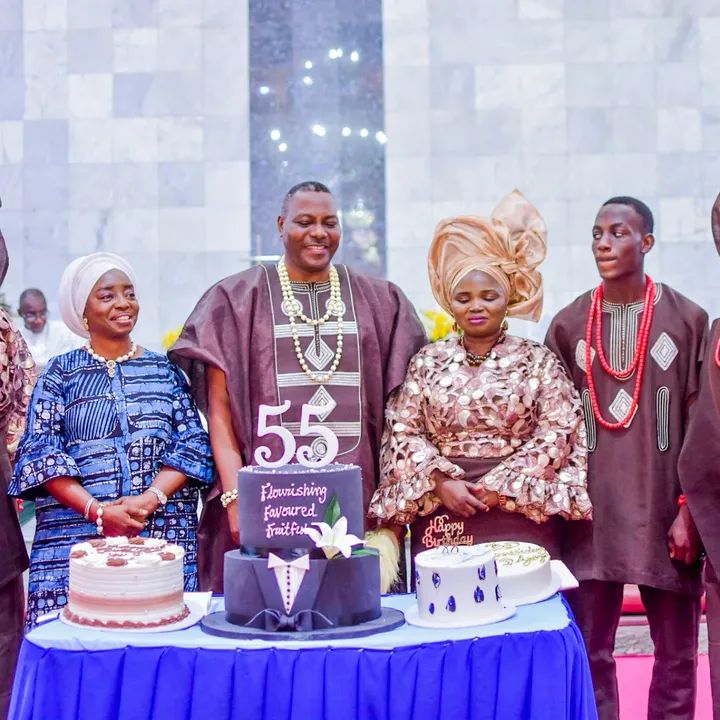
Rev Dr Oladele Ajayi is the Presiding Chaplain, Chapel of Christ the Light (Interdenominational), Alausa, Ikeja, Lagos. He recently celebrated his 55th birthday with a Thanksgiving service at the same Chapel.
In this interview, he shared with Gracious Akintayo his journey into drama artistry, lecturing, ministry, and his opinion on the state of the Church, society, among other things. Excerpt:
How would you describe your life at 55 years on earth?
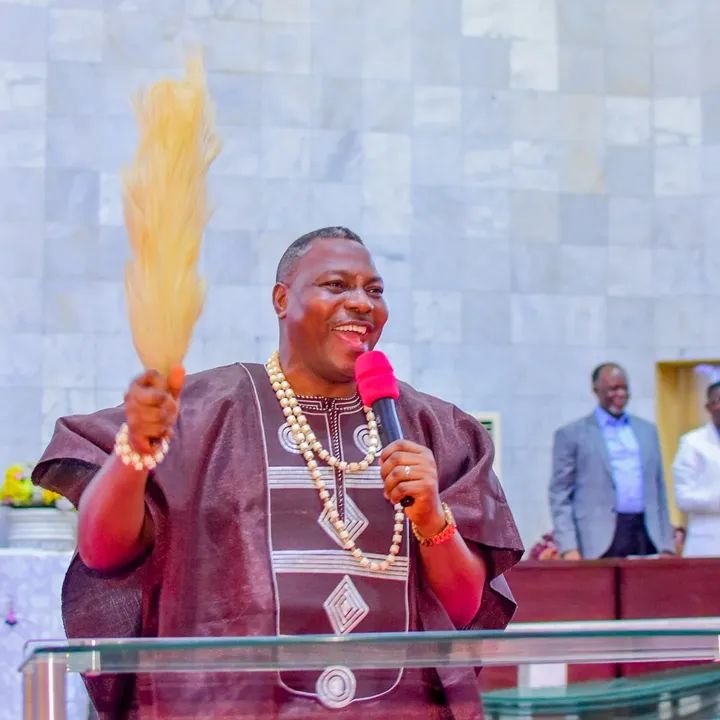
Rev Dr Oladele Ajayi with horsetail praising God.
I thank God because He has been good to me, and life has been good to me. I was born in Ilorin, but left home at the tender age of 5. I attended private schools from the nursery, and have been in Lagos since 1973. However, in 1979, the Lagos government came up with free education and changed back to public school, which enabled me to complete my secondary education at Ikosi High School, Ketu, in 1987. But rejoined with my parents at the end of my class 3, and after my secondary school at Ketu, I came to my area in Mushin, to seek admission, but found myself cutting people’s hair with a comb and a blade.
A friend of my Dad saw me cutting people’s hair on the street. He directed me to Mushin Local Government for training and empowerment initiatives to sponsor me in starting a barbing salon. I went there, and after about a month of training, I was empowered with a loan to start a barbing salon. Meanwhile, I was introduced to Rimax Institute, and I applied to study Business Administration. When I got back home from the Local Government, I received an admission letter as one of the shortlisted candidates, and I resumed schooling there. While living off campus, I was not wise enough then to manage the two together.
In my second year, one of our lecturers looked at me and said, I have the natural look of an actor. Though the talents were already there, while in nursery, primary, and secondary School, I acted and danced, also represented my primary school. When I was in class three, my late uncle was more concerned about my education, and he stopped me from doing anything artistic, but encouraged me to focus on my studies.
After the lecturer remarked, I inquired about the school’s theatre art department from a coursemate, who bears the same surname, Wale Ajayi, and was involved in the School’s theatre act. He took me there, and I realised they have a big troupe, Rimax Troupe. I auditioned and got admitted. Quite a number of those in that troupe are well-known actors today.
In the same year I joined them, I became the troupe secretary, and we were invited to give a presentation on behalf of the school. There was a Commissioner for Information in Ogun, and the director of Lagos State Council of Arts and Culture, late Mr Gbenga Sonuga, who invited us to participate in the Lagos State Festival of Arts and Culture. After that, we did some cultural presentations, including the opening of the Etiosa local government at Glover Road.
I was part of the 15 contingent that represented Lagos State in a medley chorus at the 1989 National Festival of Arts and Culture in Bauchi. Also, in 1990, I was part of the team that represented Lagos State in dance drama at the National Youth Festival Ilorin, Kwara State. I was more in the arts, and after I finished my studies, I attended a workshop facilitated by Professor Wole Soyinka.
At the time of my industrial attachment, Mr Gbenga Sonuga admitted me into the admin department of Lagos State Council for Arts and Culture, Onikan. While there, an opportunity came for a workshop organised by collective artists, led by Chuck Mike. But to participate, I must have 10 years of experience and a guarantor to recommend me. But I didn’t have 10 years of experience, and I went to the respective camps at Badagry and Epe. By the time I got to the camp, I was involved in everything they were doing. He saw those things and recommended me for the two-month workshop.
At the same time in 1990, my church, Christ Apostolic Church, sponsored me to attend a two-month weekend Sunday school Bible training at the C.A.C headquarters. Thereby, during the week, I would be learning arts where you had the likes of Yinka Davies and other top actors. My dance tutor was Uncle Yemi Remi, a good dancer, and on weekends, I’m at Sunday school Bible training.
There was also a large cast play, Spirit of Lagos, sponsored by the Lagos State government, in which I was involved with the likes of Jide Kosoko, Nobert Young, and many others. Late Uncle Steve Rhodes was the consultant who selected few of us to record the musical in the recording studio. I was exposed to all manner of art while it lasted.
After the training and graduation from Rimax Institute, the school provost called me and expressed delight in my exploits, especially with the Lagos State Council for Arts and Culture. The school recalled me to lecture at the Theatre Arts Department.
In 1992, sensing the call of God in my life, my contract with Performance Studio Workshop of the Collective Artist (PSW) had expired, and I didn’t bother to renew it. Instead, the three of us, myself, Femi Bolorunde, and Albert Akaeze started Jesus Evangelical Theatrical Services (JETS). We were doing three-man shows everywhere, on TV, and in churches. We did one that had a large crowd of about 38 casts. Femi Bolorunde wrote the story titled “Living in Bondage”. It was a staged play we performed at different churches. It was later changed to Living Under Bondage because another film, not associated with us, was titled Living in Bondage.

After the play, people asked for the tape, and we planned to make it a film, but couldn’t raise the total production cost, which was estimated at N300,000. I started visiting banks, places, and organisations in search of sponsorship, but that yielded nothing.
As a result, I became a gospel artist manager, managing Sister Dupe Olulana. While still in CAC, I was also assisting different churches in their programmes.
In September 1992. I decided to go into full-time Christian ministry. I was also lecturing in some Bible schools while managing some artists.

My last play was in 1995, when the calling into the pastoral ministry came, and in 1996, God told me to attend a Bible School in Ikorodu, which I later found to be LIFE Theological Seminary.
God brought me out of a particular system through a peculiar process to a purposeful system, and it has been an adventurous journey with exposure.
My pastor was Pastor Femi Agboola of Prayer Link Evangelical Ministry. I was with him, pastoring and managing two places at the same time, Obalende and the Ikorodu branch of the church. We do the Friday vigil at Ikorodu, and move to Obalende the next morning for the Saturday meeting. No Sunday services in those places; only at the headquarters do we have Sunday services.

During these life journeys and experiences, what was going on in your mind?
As a young man, my life was about God and how to serve Him. From when I was in class three, I was always in the church. Whenever they looked for me at home and couldn’t find me, they knew I would be in the church. I was involved in singing and drama. At least one activity always kept me in the church, and I later became the CAC district drama coordinator.
How were you able to navigate the environmental lifestyle and addictions?
It was the grace of God because we were always in the church. We had our own responsible way of interaction with others because we lived in the same area of Onipan and Mushin. We were not part of the bad boys, and were not wayward, since that was the major problem among the young people in that area. We were conscious of Christianity. We were sold out for God from a tender age, and always in the church. The structure that brought us up solidified our Christian foundation. The messages we heard helped us with the level of our discipline at CAC. I grew up with the message not to commit fornication. When I eventually got to the Bible school, things were fine with me; I had no distractions.

God told me to attend a Bible school, which I never heard of. I got to the school through a connection. It was when they called me for the oral exam that I knew it was an extension of the Foursquare Gospel Church.
In my admission testimonial, I wrote that, with my understanding, I wouldn’t have been at the school because I felt the Foursquare Church was too democratic, and not spiritual. That was my understanding from where I was coming from. I wouldn’t have been there, but God asked me to go, and He proved Himself throughout my duration in the school. I was living in the Solomade area, and the school was a distance; sometimes I trekked to school.
How would you describe your relationship with God in this journey of faith?
It has been great with God in this journey of grace because I didn’t plan to be where I am today. It is only God. I was taking care of my family and going about my pastoral duties, with the privilege of my first degree, back for my master’s and later my PhD at the Institute of International Church Growth. With that, I was lecturing here and there as an adjunct lecturer. Also, pastoring a local Church and going to school.
Then, I was on my own and not involved with the PFN, and naturally, I didn’t want anything to do with them. But my friends were persuading me to join PFN.
Before I left Shomolu, I allowed them to use the local church I was pastoring for their meetings, and they awarded me the Best Accommodating Pastor, when I was not one of them. But all the PFN pastors in Shomolu were my friends, and I attended several seminars and training with them.
I later left to reside at Ketu and was involved in the local churches, helping to train their pastors and workers. It was there that I finally got involved with PFN. They started PFN Kosofe Province, and the pioneering chairman, Pastor Leke Akinola, brought me in as the province’s youth director. He later involved me in another directorate, registration and computerisation. While doing this, I became Lagos PFN Assistant Youth Director, and today the State Director of Interministerial.
How do you become the Chaplain at the Chapel of Christ the Light, Alausa?
One day, someone drew my attention to an advert on our platform, about a vacancy in the chaplaincy in the Chapel of Christ the Light. I applied with the knowledge that I can do it, I met the requirements, and came for the interview. Somehow, they didn’t pick me, and I left. When another opportunity came, I applied again and sat for the interview, and was picked. Since then, it has been a wonderful journey and service of grace.
What is your opinion on the spate of sexual immorality among some pastors, especially the younger ones?
The gospel truth about this challenge is that, in my first degree thesis presentation, I wrote on mentorship, and in my first PhD, I wrote on evangelism that works. But in 2014, I wrote about it as my master’s project, “Curbing sexual problems among ministers”. The solution to sexual immorality among ministers is in Proverbs 6: 23-29.
How do you compare your upbringing through church activities to present-day church activities?
There are some differences. Then, there was more hunger for God and a desire to serve Him. Today, we have more activities than in those days, but with less hunger for God. As young ones, we went to church with the mind of knowing God and serving Him, not just to be a church member, or about happenings in the church, or the pastor’s popularity, nor what to get from the church. It was about how to please God, be a good Christian, what to do for God, and how to be useful for His kingdom and society; that was our mindset. But today, we have a mixed multitude, many coming to church, because of what they want, not to know God, or serve Him. Some come to Church because it’s popular, and the pastor performs miracles or prophesies. Only a few people come to church to hear God’s word, know God, and serve Him.
What do you think is responsible for this?
There’s civilisation, and many of the ministers are not theologically sound and ministerially equipped. Many have the call, but they are not patient enough to be trained. That is where mentoring, discipleship, and training come in handy.
There is always formal and informal training. Informal training is what you get from mentors, teachers, and people around you. But formal training is important, for it is where you learn and develop to interpret the Bible correctly. This is lacking among many ministers, and we have many theological bankruptcies, with heresies everywhere.
Today, many churchy people are not regenerated, the same with many pastors, and there are many churches, but less impact because the younger ones are mostly given to drugs, yahoo-yahoo, yahoo plus, and quick money syndrome.
Many claimed to be born again, but the process of regeneration has been cut short or not well-formed. Meanwhile, regeneration is a continuous doctrine of sanctification. The more you come to God’s word, the more it cleanses you and renews your mind. When that is done, it’s easy to understand your motive to serve God.
What do you think is the solution to return the past foundation glory?
One thing the church can do is to be realistic by bringing the Bible into today’s reality and speaking today’s language. Then teach people the basic things that the Bible talks about on holiness and obedience to God.

